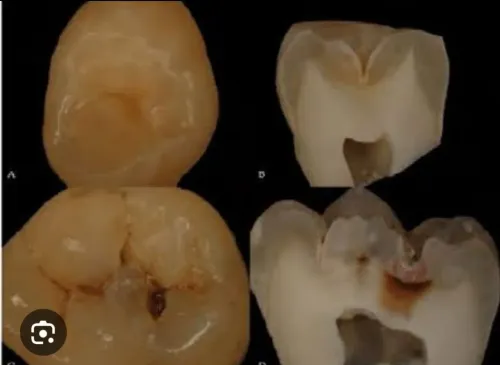

Dental caries (tooth decay) occurs when acids produced by bacteria gradually demineralize and destroy the hard tissues of the tooth (enamel and dentin). It develops through a series of biological and chemical steps.
1. Dental Plaque Formation
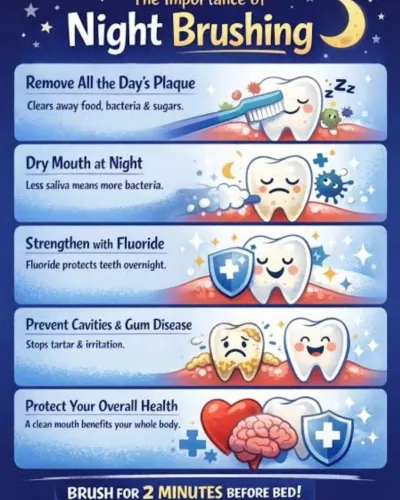
After eating, especially sugary or starchy foods, bacteria in the mouth attach to the tooth surface.
These bacteria form a sticky film called dental plaque.
Important bacteria involved include Streptococcus mutans and Lactobacillus species.
Key idea: Plaque acts as a biofilm that holds bacteria against the tooth.
2. Acid Production by Bacteria
When you consume sugars (sucrose, glucose, fructose), plaque bacteria ferment these carbohydrates.
This fermentation produces organic acids, mainly lactic acid.
The acid lowers the pH of the plaque below about 5.5.
At this low pH, tooth enamel begins to dissolve.
3. Demineralization of Enamel
Tooth enamel is mainly made of hydroxyapatite crystals.
Acid causes loss of calcium and phosphate ions from enamel.
This process is called demineralization.
Early sign: white spot lesion on enamel.
Saliva can sometimes remineralize enamel if the damage is mild.
4. Progression to Dentin and Cavity Formation
If the process continues:
Enamel breaks down.
Bacteria reach dentin, which is softer and decays faster.
A cavity forms.
If untreated, decay can reach the pulp, causing pain and infection.
This may lead to pulpitis or dental abscess.
✅ In simple terms:
Bacteria + sugar → acid → enamel demineralization → cavity
Key Factors Required for Caries (Keyes’ Triad)
Host (tooth)
Microorganisms (bacteria)
Substrate (fermentable carbohydrates)
Keywords